
The international conference Tradition, Innovation and Migration: Digital Palaeography in Search of Wandering Scribes and Books takes place from 8–10 December 2025 in Aubervilliers, France.
In the Middle Ages, Hebrew Manuscripts were produced across the vast Jewish diaspora from France and Portugal in the west to the borders of China in the East, from England in the north to Yemen in the south. Each culture had its own bookmaking traditions and models of the script. However, these different, often remote centres were not isolated. Texts, books and ideas travelled along commercial routes or roads of exile. The conference “Tradition, innovation and migration: Digital palaeography in search of wandering scribes and books” explores the impact of geographical mobility on the transmission and development of the Hebrew scripts. ‘Mobility’ or ‘migration’ is defined broadly. It concerns the impact of travel for learning or trade on the circulation of the models of the Hebrew script, follows individual scribes who for whatever reason abandoned their place of origin and exercised their scribal craft in a new environment and deals with networks of scribes across space. ‘Mobility’ and ‘migration’ are understood as a methodological framework to understand the transformation of the Hebrew script in a longue durée perspective. The phenomenon of the mobility of scribes, models, and scripts is studied through the most recent traditional, digital, and AI-based methodologies in Hebrew palaeographical research.
The program cen be found here.
Event Type
Continent
Country
Subject period (wide)
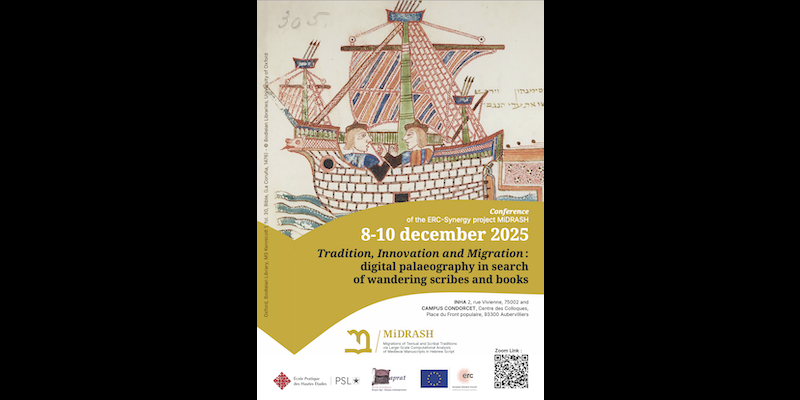
The international conference Tradition, Innovation and Migration: Digital Palaeography in Search of Wandering Scribes and Books takes place from 8–10 December 2025 in Aubervilliers, France.
In the Middle Ages, Hebrew Manuscripts were produced across the vast Jewish diaspora from France and Portugal in the west to the borders of China in the East, from England in the north to Yemen in the south. Each culture had its own bookmaking traditions and models of the script. However, these different, often remote centres were not isolated. Texts, books and ideas travelled along commercial routes or roads of exile. The conference “Tradition, innovation and migration: Digital palaeography in search of wandering scribes and books” explores the impact of geographical mobility on the transmission and development of the Hebrew scripts. ‘Mobility’ or ‘migration’ is defined broadly. It concerns the impact of travel for learning or trade on the circulation of the models of the Hebrew script, follows individual scribes who for whatever reason abandoned their place of origin and exercised their scribal craft in a new environment and deals with networks of scribes across space. ‘Mobility’ and ‘migration’ are understood as a methodological framework to understand the transformation of the Hebrew script in a longue durée perspective. The phenomenon of the mobility of scribes, models, and scripts is studied through the most recent traditional, digital, and AI-based methodologies in Hebrew palaeographical research.
The program cen be found here.