From the EHRI website:
Holocaust testimony archives preserve hundreds of thousands of audiovisual interviews documenting persecution, displacement, deportation, and survival. Yet existing testimony portals still primarily rely on keyword search, manually curated indexing vocabularies, and collection-level metadata, making it difficult for historians to identify semantically related experiences, analyse emotional expressions, or compare survivor narratives across collections. This webinar presents VOICES, a Digital Humanities framework developed in collaboration with Holocaust historians to support multimodal exploration of survivor testimonies through knowledge graphs and semantic technologies.

The first part of the talk will introduce the conceptual foundations of VOICES, including the limitations of existing testimony exploration systems, the role of semantic technologies for modelling survivor narratives, and the knowledge graph construction pipeline combining event extraction, emotional annotations, multimedia alignment, and semantic similarity analysis. The second part will demonstrate the VOICES exploration environment, which enables historians to move between corpus-level exploratory analysis and close reading of individual testimony fragments through emotional visualisation, narrative-flow exploration, semantic retrieval, and cross-testimony comparison workflows. The webinar will also discuss interoperability with EHRI and broader implications for Holocaust research, oral history, and Digital Humanities infrastructures. This presentation is by the FNR / DFG VOICES project.
Presenters: Cedric Pruski (Luxembourg Institute of Science and Technology), Mohamed Laib (Luxembourg Institute of Science and Technology), Marcos da Silveira (Luxembourg Institute of Science and Technology), Gabor Mihaly Toth (University of Luxembourg)
Gabor Mihaly Toth (PI) is a computational historian with vast experience of working with oral history testimonies of the Holocaust. Previously, he worked at two Holocaust testimony archives in the US. As a computational historian, he specialised in the application of data science and advanced statistics to study memory and lost / incomplete historical collections. His previous projects were funded by Google, the Gerda Henkel Stiftung, Arts and Humanities Research Council (UK), and recently by the Irish Research Council.
Marcos Da Silveira brings over 15 years of experience as a senior researcher in knowledge engineering at LIST. His expertise covers dynamic knowledge management, semantic annotation generation, and data analytics. He has a strong track record supervising PhD students and postdocs. He is a member of the Deep History PhD program at C2DH.
Cédric Pruski is senior researcher at LIST. He is specialised in knowledge engineering and knowledge evolution management. He wrote numerous papers and holds patents in the fields of ontology engineering and semantic annotation. He currently (co-)supervises a PhD thesis in the Deep History PhD program of C2DH.
Mohamed Laib is a junior scientist at the LIST. His main background is in statistics and machine learning with a focus on feature selection and time series.
EHRI Webinar
EHRI Webinars are in general free and without registration.
Time: Oct 7, 2026; 03:00 PM CET
Join Zoom Meeting here:
https://zoom.us/j/99866101574?pwd=RSwSl9MzCBaPahZbOdp9afXaPaOH30.1
Meeting ID: 998 6610 1574
Passcode: 226063
Event Type
Continent
From the EHRI website:
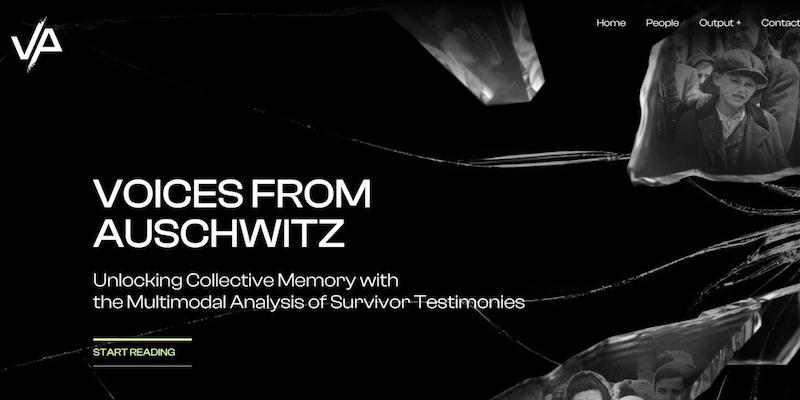
Holocaust testimony archives preserve hundreds of thousands of audiovisual interviews documenting persecution, displacement, deportation, and survival. Yet existing testimony portals still primarily rely on keyword search, manually curated indexing vocabularies, and collection-level metadata, making it difficult for historians to identify semantically related experiences, analyse emotional expressions, or compare survivor narratives across collections. This webinar presents VOICES, a Digital Humanities framework developed in collaboration with Holocaust historians to support multimodal exploration of survivor testimonies through knowledge graphs and semantic technologies.
The first part of the talk will introduce the conceptual foundations of VOICES, including the limitations of existing testimony exploration systems, the role of semantic technologies for modelling survivor narratives, and the knowledge graph construction pipeline combining event extraction, emotional annotations, multimedia alignment, and semantic similarity analysis. The second part will demonstrate the VOICES exploration environment, which enables historians to move between corpus-level exploratory analysis and close reading of individual testimony fragments through emotional visualisation, narrative-flow exploration, semantic retrieval, and cross-testimony comparison workflows. The webinar will also discuss interoperability with EHRI and broader implications for Holocaust research, oral history, and Digital Humanities infrastructures. This presentation is by the FNR / DFG VOICES project.
Presenters: Cedric Pruski (Luxembourg Institute of Science and Technology), Mohamed Laib (Luxembourg Institute of Science and Technology), Marcos da Silveira (Luxembourg Institute of Science and Technology), Gabor Mihaly Toth (University of Luxembourg)
Gabor Mihaly Toth (PI) is a computational historian with vast experience of working with oral history testimonies of the Holocaust. Previously, he worked at two Holocaust testimony archives in the US. As a computational historian, he specialised in the application of data science and advanced statistics to study memory and lost / incomplete historical collections. His previous projects were funded by Google, the Gerda Henkel Stiftung, Arts and Humanities Research Council (UK), and recently by the Irish Research Council.
Marcos Da Silveira brings over 15 years of experience as a senior researcher in knowledge engineering at LIST. His expertise covers dynamic knowledge management, semantic annotation generation, and data analytics. He has a strong track record supervising PhD students and postdocs. He is a member of the Deep History PhD program at C2DH.
Cédric Pruski is senior researcher at LIST. He is specialised in knowledge engineering and knowledge evolution management. He wrote numerous papers and holds patents in the fields of ontology engineering and semantic annotation. He currently (co-)supervises a PhD thesis in the Deep History PhD program of C2DH.
Mohamed Laib is a junior scientist at the LIST. His main background is in statistics and machine learning with a focus on feature selection and time series.
EHRI Webinar
EHRI Webinars are in general free and without registration.
Time: Oct 7, 2026; 03:00 PM CET
Join Zoom Meeting here:
https://zoom.us/j/99866101574?pwd=RSwSl9MzCBaPahZbOdp9afXaPaOH30.1
Meeting ID: 998 6610 1574
Passcode: 226063